
The Ultimate Guide to Tteokbokki: The Red Soul Food That Comforts K-Drama Protagonists
If you are a foreigner visiting Korea or someone who loves K-dramas, you have undoubtedly seen scenes where students in school uniforms and office workers getting off work happily eat a bright red dish at a local snack eatery (Bunsikjip). The absolute synonym and heartbeat of Korean street food is none other than 'Tteokbokki'.
Often introduced abroad as 'Spicy Korean Rice Cakes', this dish possesses a magical charm that makes it impossible to escape once you taste the combination of chewy rice cakes and intense red sauce. Go beyond mere spiciness and dive into the trendiest icon of K-Food, where an explosion of sweetness and savory umami awaits.
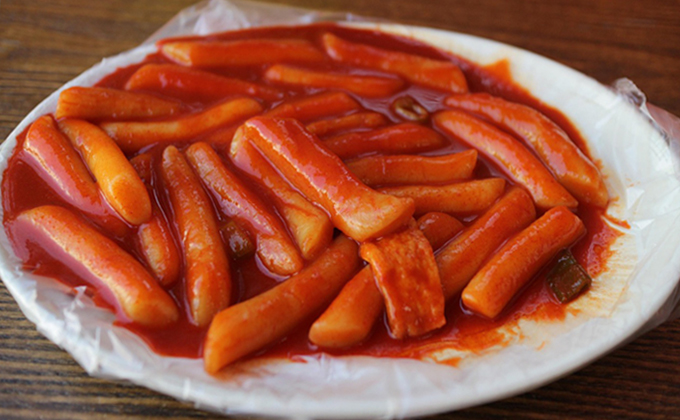
Evolution from Royal Cuisine to the People's Spicy Treat
Modern red Tteokbokki gives off a very intense and fiery image, but its origins hold a surprising twist dating back to the royal court of the Joseon Dynasty. Originally, Tteokbokki started as 'Gungjung Tteokbokki' (Royal Court Tteokbokki), a top-tier dish where precious beef and vegetables were stir-fried with rice cakes in a sweet and savory soy sauce.
This non-spicy dish, once served only on the King's table, was popularized in a completely new way right after the Korean War in the 1950s in Sindang-dong, Seoul. Vendors began simmering wheat flour rice cakes in a sauce made by mixing Chunjang (black bean paste) and Gochujang (red chili paste). Affordable and highly stimulating, this new street food quickly established itself as the perfect soul food to soothe the sorrows of everyday commoners.
The Addictiveness of Chewy Texture and Sweet-Spicy Sauce
The part that foreigners find the most unfamiliar yet attractive when eating Tteokbokki is the unrivaled 'Texture' of the rice cake. The core is the 'Chewy' texture that sinks in softly the moment it touches your teeth while maintaining a delightfully bouncy elasticity.
Added to this is the sauce simmered with a base of 'Gochujang', Korea's fermented chili paste. It showcases the ultimate 'Sweet and spicy' balance, where the tongue-pricking heat is smoothly wrapped by a subtle sweetness drawn from sugar and green onions. The sight of the thick, reduced red sauce thoroughly coating the chewy rice cakes delivers a visual gastronomic perfection as well.
A Practical Gourmet Course from a Traveler's Perspective
Tteokbokki is delicious on its own, but when enjoyed with side dishes like Koreans do (pairing), the satisfaction skyrockets by 200%.
The 'Dipping' (Jjik-meok) Combo Experience at a Bunsikjip
When ordering Tteokbokki at a traditional market snack eatery, be sure to order clear 'Fish cake' (Eomuk) soup and crispy 'Fried snacks' (Twigim) alongside it. The red Tteokbokki broth itself acts as a magical dipping sauce. Dunking crispy fried squid deep into the hot sauce, and sipping the warm fish cake broth when the spiciness hits, will cleanly reset your palate.
Tasting the Rosé Tteokbokki from K-Dramas
Korea's bright red spiciness can be quite overwhelming for foreigners. If you are weak to spice, try ordering 'Rosé Tteokbokki', which mixes Gochujang with smooth, rich cream, or add a waterfall of melted cheese on top. This fusion menu, recently beloved by K-drama heroines and turning into a global trend, wraps the capsaicin sting in a creamy embrace.
Visiting Sindang-dong Tteokbokki Town
If you want the fun of cooking it yourself, visit 'Sindang-dong Tteokbokki Town' located in Jung-gu, Seoul. It is the mecca of 'Jeukseok Tteokbokki' (Instant Tteokbokki), where you place a pot filled with various ingredients like rice cakes, cabbage, ramyeon noodles, and jjolmyeon (chewy noodles) on a gas burner right at your table and boil it on the spot.
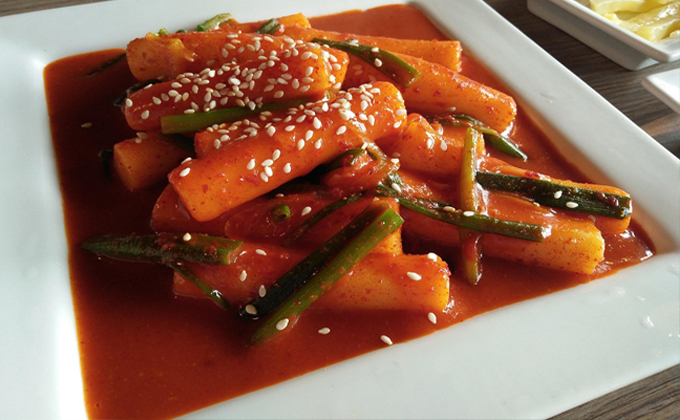
Dining Tips to Keep in Mind
The hot, thick red broth can easily splatter on your clothes when you chew the noodles or rice cakes, and once stained, it is very difficult to remove. Requesting and wearing an 'Apron', usually provided by the restaurant, before eating is a great tip to protect your travel outfits.
Also, to create a deep flavor, Tteokbokki sauce or broth fundamentally includes anchovy stock or fish cakes (processed fish meat) in most cases. Strict vegan travelers or those with seafood allergies must be aware of this in advance.
Key Takeaways
- It is Korea's iconic sweet and spicy street snack that appears most frequently in K-dramas and movies.
- The extremely bouncy and 'chewy' texture of the rice cake, rarely found in Western cuisine, delights the mouth.
- The unspoken local rule is to dip crispy fried snacks or Gimbap deeply into the thick, Gochujang-based sauce.
- If the spiciness is too much, you can comfortably start with Rosé Tteokbokki mixed with cream or a menu topped with cheese.
- Since the red broth can splatter on clothes, request an apron, and it's best to order a sweet drink to soothe the heat.