
Gwanghwamun Square Travel Guide: A Wide, Symbolic Walk Through the Political and Historical Heart of Seoul
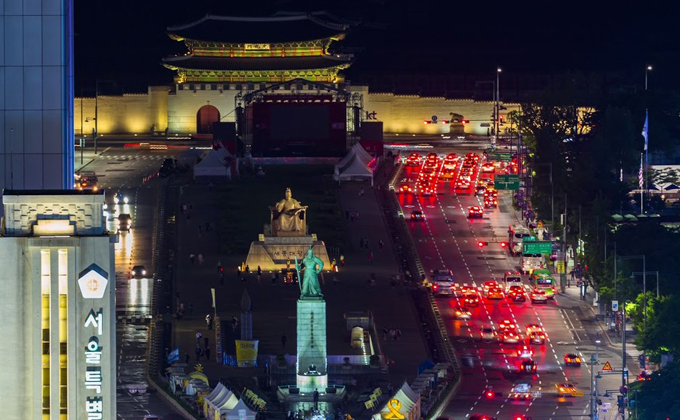
If you want one place in Seoul that immediately feels important even before you fully understand why, Gwanghwamun Square is a strong candidate. The setting alone carries weight: the axis stretching toward Gyeongbokgung Palace, the mountain backdrop, the government district, the major monuments, and the constant flow of residents, workers, students, and travelers moving through the center of the capital. It is not merely a plaza. It is one of the clearest expressions of how Seoul layers national history and modern city life on top of each other.
For travelers, the square is useful in two ways at once. First, it is a destination in its own right, with major statues, water features, green space, and wide sightlines that make it pleasant to walk. Second, it is one of the best base points in central Seoul. From here, you can connect naturally to Gyeongbokgung, Seochon, Insadong, Cheonggyecheon, and other high-interest neighborhoods without the route ever feeling forced.
A redesigned public space that feels greener, broader, and more welcoming than before
The version of Gwanghwamun Square visitors see today reflects a major redesign. After a long renovation period, the square reopened in August 2022 with a dramatically expanded pedestrian area and a stronger emphasis on greenery, rest space, and public use. That matters because the area no longer feels like a leftover strip squeezed between traffic lanes. It feels much more intentional as a place to walk, pause, and spend time.
The result is a central Seoul space that breathes better than many first-time visitors expect. Trees, planting, seating zones, and broader walking areas help soften what might otherwise feel too formal or governmental. The setting still carries ceremonial weight, but it is also approachable. You can come here for symbolic monuments and major sightlines, or simply for a city walk that feels open and well framed.
How to enjoy Gwanghwamun Square like a traveler with limited time
This is one of those places where a little route planning pays off quickly.
Frame the monuments with the city’s oldest and newest layers in one shot
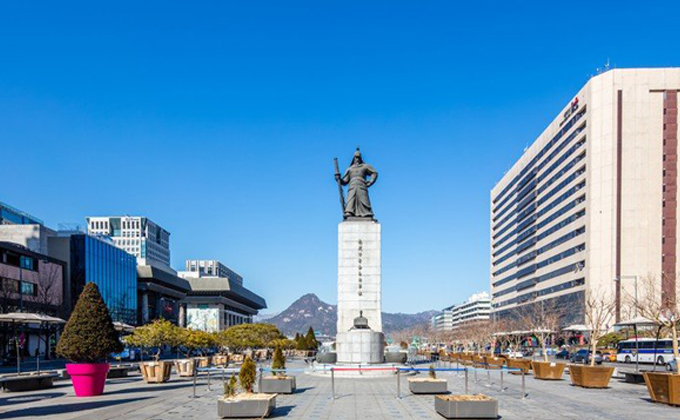
The statues of Admiral Yi Sun-sin and King Sejong are the square’s best-known landmarks, and they are more than generic memorials. They anchor the historical identity of the space. If you compose your photo carefully, you can often bring together the statue, the palace axis, and the mountain backdrop in a single frame. That visual overlap is exactly why this area leaves such a strong impression. You are not looking at one period of Korea. You are looking at multiple eras sharing the same view.
Come back after dark if you can
Gwanghwamun is already impressive during the day, but evening adds another layer. Lighting, media art, and the glow of surrounding buildings shift the mood from civic and historical to more atmospheric and contemporary. A summer or early-fall evening walk here can feel especially rewarding because the area stays active without becoming chaotic.
Use it as a launch point rather than an isolated stop
One of the smartest ways to handle central Seoul is to let Gwanghwamun Square organize your day. Head north into Gyeongbokgung if you want palace architecture and royal history. Move west toward Seochon for cafes and a more local-feeling urban texture. Walk east toward Insadong and Cheonggyecheon if you want crafts, souvenirs, and a broader downtown route. The square is not a dead end. It is a hinge.
Slow down enough to notice the mood of the place
Because it appears on so many itineraries, some people rush through it too fast. But the appeal is not only in checking off a monument list. It is in seeing office workers cross paths with school groups, hearing multiple languages in the same public space, and watching one of the city’s most symbolic areas function as a living part of daily Seoul.
Things to keep in mind before you go
Weekday lunch hours can get quite busy because the surrounding area includes major offices, government institutions, and cultural facilities. If you are hoping for a calmer stroll or cleaner photos, avoid the peak noon rush when possible. The square is large enough to absorb crowds better than many Seoul sidewalks, but you will still feel the difference.
Water features and fountains can also affect your visit more than you might expect, especially in warm weather. They add to the atmosphere, but if you are carrying a camera, open drink, or exposed electronics, it is smart to stay aware of where the water jets are active. Families and children often gather around these zones, which can make them lively but also less predictable.
Quick takeaways
- Gwanghwamun Square is one of Seoul’s most symbolic public spaces, linking royal history, civic identity, and present-day city life.
- The square reopened in a much larger and greener form in 2022, making it more pleasant and more walkable than before.
- Photos work especially well when you frame monuments with palace and mountain lines in the background.
- Evening visits can be especially rewarding thanks to lighting, media art, and the broader nighttime atmosphere.
- It is best used as both a destination and a base point for connecting to Gyeongbokgung, Seochon, Insadong, and nearby central Seoul routes.